


L'utilisation de machines hydrauliques peut vous amener à vous trouver dans diverses situations exigeant une grande précision de contrôle. L'une d'elles concerne le levage de machines et de marchandises sensibles nécessitant un contrôle de mouvement très précis (au pouce près et au millimètre près). Les distributeurs proportionnels hydrauliques permettent de réguler le mouvement à ce niveau de précision. Ces distributeurs assurent un mouvement très précis en convertissant des signaux d'entrée numériques (électriques) en un mouvement mécanique proportionnel de l'élément du distributeur.
L'élément fondamental de ces vannes est un actionneur électromagnétique qui positionne avec précision le filament ou le disque de la vanne en fonction du signal reçu. Ceci permet à l'utilisateur d'alterner indéfiniment entre une position complètement fermée et une position complètement ouverte.
Principe de fonctionnement des vannes proportionnelles
L'étape cruciale de l'utilisation d'une vanne proportionnelle consiste à la raccorder au système de commande. Ce système doit envoyer un signal de fonctionnement pour ouvrir ou fermer la vanne. De plus, la vanne doit être installée dans l'orientation appropriée afin de garantir le bon sens d'écoulement et une position de montage correcte ; dans le cas contraire, elle ne fonctionnera pas correctement.
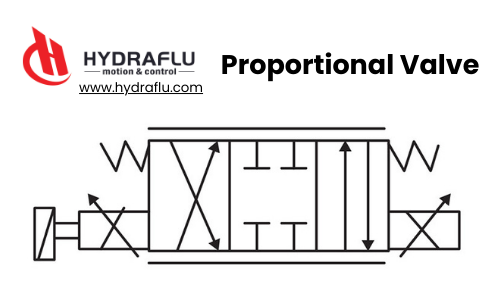
Vérifiez que le signal de commande est calibré conformément aux spécifications de la vanne et que les connexions électriques sont bien serrées. L'électronique de commande de la vanne analyse le signal d'entrée et ajuste le courant de l'actionneur en conséquence. Ceci génère une force magnétique à l'intérieur de la vanne, qui s'oppose à la force d'un ressort et propulse l'élément de la vanne (comme illustré ci-dessous).
Cette fonction permet un contrôle précis de la position. C'était le principe de fonctionnement des vannes proportionnelles de base, mais il existe aussi des vannes proportionnelles plus sophistiquées.
L'une de ces vannes perfectionnées est appelée vanne à boucle fermée. Elle assure une surveillance et un ajustement continus de la position de la vanne afin de maintenir le débit souhaité. Même dans des conditions de fonctionnement variables, cela garantit des performances précises et constantes. L'utilisation d'électrovannes proportionnelles, qui réagissent aux variations de signaux électriques (tension ou courant), confère également à ces vannes des performances supérieures à celles du modèle de base. Pour un contrôle précis du débit, elles permettent d'appliquer une force variable pour déplacer le tiroir contre un ressort.
Améliorations de conception
De nombreux fabricants intègrent de petites encoches en V dans le tiroir pour réduire le temps de réponse du fluide. Ces encoches garantissent un meilleur fonctionnement en permettant au fluide de s'écouler immédiatement dès le déplacement du tiroir. Grâce au positionnement continu du tiroir, les débits peuvent être modifiés à l'infini, car il n'existe aucune limite fixe à l'entrée qui détermine le débit de sortie.

Procédures d'installation et de configuration de la vanne proportionnelle
Installation d'un vanne proportionnelle L'installation est un peu technique en raison de ses raccords de commande. Avant toute chose, les besoins du système en pression et en débit détermineront le type et la taille de la vanne à utiliser. Pour commencer l'installation, la vanne doit d'abord être positionnée dans le système à un emplacement approprié, généralement un endroit où la pression peut dépasser les limites admissibles. L'installation des vannes à pilotage automatique est plus complexe et nécessite notamment la configuration des conduites pilotes externes et la garantie d'une fixation sécurisée des raccords de commande.
Une fois installée et calibrée, la vanne doit être testée afin de garantir son bon fonctionnement sous pression. Généralement, cette opération consiste à pressuriser le système et à observer la réaction de la vanne aux variations de pression.
Applications et limites des vannes proportionnelles
Les applications où la pression de sortie varie, de façon continue ou par paliers, nécessitent des vannes proportionnelles. Par exemple, une pression de sortie par paliers correspond au maintien d'une pression à une valeur donnée avant de passer à une autre.
À l'inverse, une pression de sortie constante est un processus par lequel la pression augmente toujours à un rythme déterminé. Cette caractéristique distingue les vannes proportionnelles des autres types de vannes et leur confère ainsi des applications spécifiques, comme dans les systèmes de freinage ABS. Parmi les nombreuses applications typiques, on peut citer :
Systèmes hydrauliques
Le contrôle de la pression et du débit hydrauliques est assuré par l'utilisation de vannes proportionnelles, qui garantissent le bon fonctionnement et l'efficacité des machines telles que les presses et les excavatrices.
Systèmes pneumatiques
Les vannes proportionnelles sont utilisées dans des applications telles que les chaînes de montage automatisées pour réguler le flux d'air car elles permettent de régler les actionneurs pneumatiques en termes de vitesse et de force.
Contrôle des processus
Pour contrôler les débits et garantir un dosage ou une gestion de la pression appropriés, des vannes proportionnelles sont utilisées dans des industries telles que le traitement chimique et le traitement de l'eau.
Industrie automobile (Utilisation de valves proportionnelles dans le freinage ABS)
Dans l'automobile, les vannes proportionnelles sont utilisées pour gérer efficacement les systèmes de freinage et modifier en temps réel les caractéristiques de la suspension. Les vannes proportionnelles étaient utilisées dans Systèmes de freinage antiblocage (ABS) et l'unité de commande hydraulique (HCU), comme mentionné précédemment. Leur fonctionnement par paliers en faisait une option fiable pour les systèmes ABS. Cependant, ils sont désormais remplacés par des systèmes électroniques, et les systèmes hydrauliques sont privilégiés dans les applications lourdes.

Autres utilisations de la vanne proportionnelle
Les vannes de régulation de débit proportionnelles sont généralement utilisées dans les systèmes de pulvérisation de peinture, les systèmes de remplissage, la distribution de fluides ou la régulation du débit dans les réservoirs. Les vannes de régulation de pression proportionnelles sont utilisées pour le freinage pneumatique, les paliers à air ou le moulage par soufflage.
Ces exemples d'utilisation illustrent la flexibilité des vannes proportionnelles dans les secteurs exigeant précision, efficacité et corrections en temps réel.
Les systèmes à boucle ouverte comportent souvent des distributeurs proportionnels pour positionner précisément les vérins ou pour accélérer et décélérer en douceur les moteurs hydrauliques. Ils présentent toutefois certains inconvénients, notamment une hystérésis de commutation, des temps de réponse relativement longs et une consommation électrique accrue.
Quelle est la différence entre une vanne de modulation et une vanne proportionnelle ?
Le contrôle de haut niveau est de type modulant ou proportionnel. La sortie d'un contrôle modulant/proportionnel varie en continu et ne se limite pas à un état ouvert ou fermé. Proportionnel signifie que l'amplitude de la sortie dépend de l'amplitude de la commande d'entrée. L'erreur détectée par le contrôleur est exploitée pour être éliminée et garantir un fonctionnement sans faille, permettant ainsi une action cohérente.
Comment entretenir et dépanner les vannes proportionnelles
Pour garantir la longévité et l'efficacité des vannes proportionnelles, il est nécessaire d'effectuer un entretien régulier :
- Vérifiez l'usure et la détérioration, notamment au niveau des joints, des actionneurs et des systèmes de rétroaction.
- Maintenez la vanne et ses alentours propres pour éviter tout problème.
- Des impulsions fluctuantes peuvent provoquer un fonctionnement imprévisible des vannes ; il est donc important de maintenir les signaux de commande stables et dans la plage appropriée.
- Lubrifiez correctement et régulièrement les pièces mobiles et exposées de la vanne avec l'huile lubrifiante recommandée par le fabricant pour un fonctionnement fluide.
- Si la vanne ne fonctionne pas correctement, vérifiez les pannes typiques, notamment les erreurs de signal électrique, les obstructions de la vanne ou un étalonnage incorrect.
En suivant ces étapes d'entretien, vous prolongerez la durée de vie de la vanne et assurerez son bon fonctionnement.
Considérations de sécurité relatives aux vannes proportionnelles
De nombreux environnements industriels utilisent des vannes proportionnelles ; toutefois, il est impératif de respecter les protocoles de sécurité afin d’éviter tout incident. Voici les principaux points à prendre en compte en matière de sécurité :
- Toujours relâcher la pression du système avant d'intervenir sur la vanne afin d'éviter les blessures accidentelles dues au fluide sous pression.
- Il est impératif de s'assurer que les composants électriques sont correctement mis à la terre et isolés.
- Les composants de la vanne peuvent mal fonctionner en cas de pression ou de température élevées.
- Pour éviter les blessures, il est crucial de surveiller fréquemment la température du système.
Conclusion
Les distributeurs proportionnels font partie des distributeurs hydrauliques précis et fiables permettant de contrôler les mouvements dans un système hydraulique. Utilisés dans des secteurs aussi variés que l'automobile et la chimie, ces distributeurs offrent de nombreux avantages par rapport à d'autres types de distributeurs. Pour en savoir plus sur les distributeurs hydrauliques, consultez [lien/adresse manquante]. Hydraflu. Hydraflu est l'une des entreprises les mieux notées en matière de qualité dans la fabrication et la fourniture de vannes hydrauliques, hayons élévateurs, moteurs à courant alternatif, moteurs à courant continu, pompes hydrauliques, groupes hydrauliques et tous les autres composants hydrauliques.
N'hésitez pas à tendre la main et envoyez une demande pour obtenir une commande personnalisée ou un devis.

