


Introduction
Ceux d'entre vous qui travaillent dans l'industrie ou un secteur connexe ont déjà vu une fonderie et des machines martelant les métaux. Toutes ces machines utilisent une sorte de presse hydraulique. Sinon, vous avez peut-être déjà vu une excavatrice soulever sans effort des tonnes de terre, ou un camion-poubelle compacter facilement les déchets solides. Toutes ces actions immenses et contrôlées nécessitent des apports relativement faibles. Mais comment ? La réponse se trouve dans la loi de Pascal. Ce principe fondamental de la mécanique des fluides stipule que lorsqu'une pression est appliquée à un fluide incompressible, elle se transmet intégralement dans toutes les directions à travers le fluide et contre les parois de son contenant. Ce confinement garantit l'absence de perte d'énergie, permettant aux systèmes hydrauliques de multiplier la force avec une efficacité et une précision remarquables.
 Comprendre la loi de Pascal : le principe fondamental
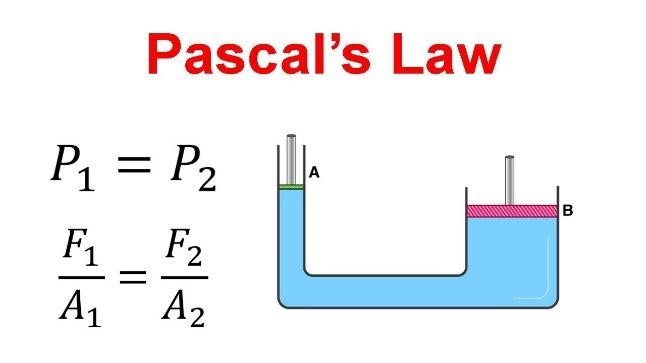 Comprendre la loi de Pascal : le principe fondamental
Pour le comprendre facilement, on peut utiliser une analogie simple (par exemple, presser un ballon rempli d'eau – il se gonfle partout de manière égale).
Formule de Pascal : P = F/A (Pression = Force / Surface)
Où P est la pression mesurée en psi/bar, F est la force appliquée en lbs/N et A est la surface sur laquelle elle est appliquée et mesurée en in²/m².
Applications industrielles de la loi de Pascal dans les composants hydrauliques clés
Cette loi dicte comment ces composants doit être conçus et interagir.
Pompes hydrauliques et loi de Pascal en hydraulique
Pompes hydrauliques Les pompes jouent un rôle crucial dans les systèmes hydrauliques industriels. Elles fonctionnent selon la loi de Pascal, convertissant l'énergie mécanique en énergie hydraulique équivalente sous forme de débit et de pression. La pompe initie ce processus en générant une force initiale sur le fluide hydraulique au sein du système étanche. Ensuite, en pressurant le fluide, elle assure une transmission de force constante et contrôlée, quelle que soit la direction du fluide.
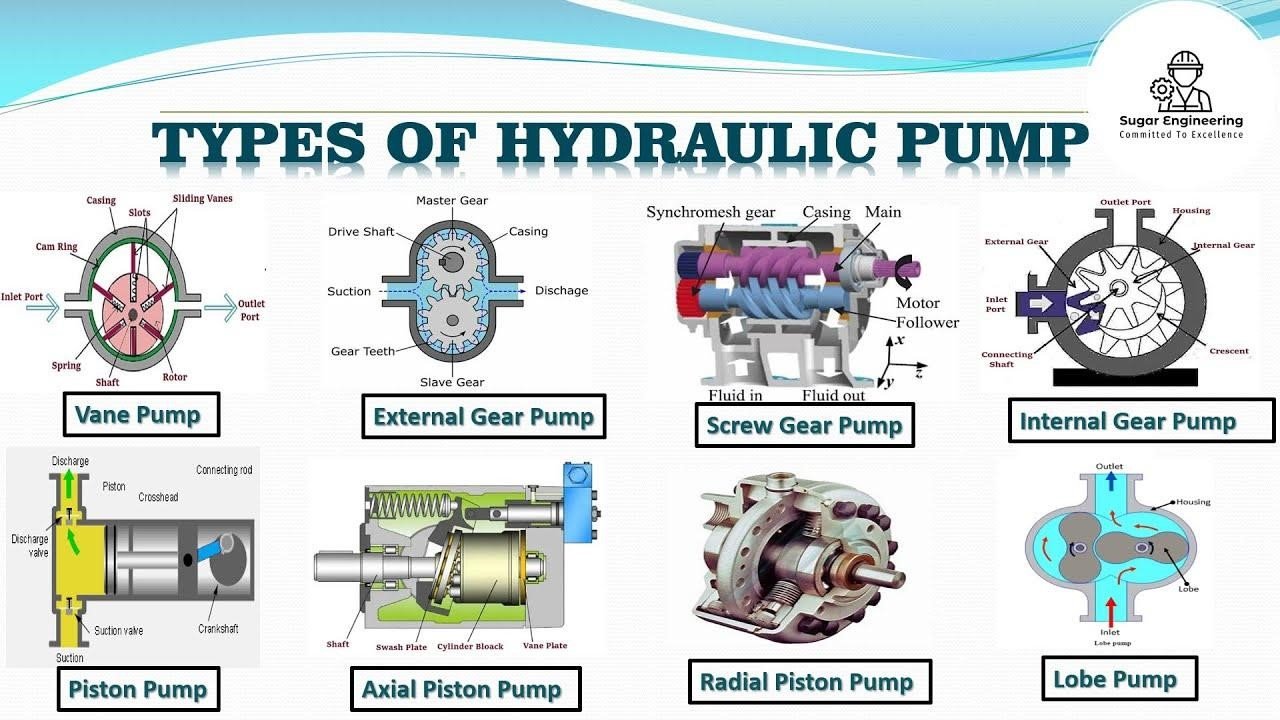 Tous les types de pompes hydrauliques obéissent à la loi de Pascal, mais le choix du type de pompe spécifique dépend de l'application visée. Il existe de nombreux types de pompes, comme illustré ci-dessous. Chacune est conçue selon la loi de Pascal, mais le travail mécanique nécessaire à la conversion de la pression en travail hydraulique diffère. Le type de pompe est sélectionné en fonction des exigences de pression, de débit et de rendement du système, car ces choix sont dictés par les besoins spécifiques de l'application en termes de vitesse, de force ou de précision. Ce choix garantit que l'énergie mécanique fournie par la pompe est efficacement transformée en puissance hydraulique utilisable, constituant ainsi le point de départ de toute opération hydraulique.
Cylindres hydrauliques et loi de Pascal en hydraulique
Tout comme les pompes hydrauliques, les vérins hydrauliques constituent un autre composant essentiel des équipements industriels. Ce sont les actionneurs qui convertissent la pression hydraulique en force et mouvement mécanique linéaire. Ils illustrent directement le principe de la loi de Pascal, selon laquelle la pression (P) appliquée à un fluide confiné s'exerce uniformément sur la surface du piston (A), générant une force linéaire conformément à l'équation. F = P × A. Cette relation permet une multiplication significative de la force, rendant possible le levage ou le déplacement de charges lourdes avec une pression d'entrée relativement faible.
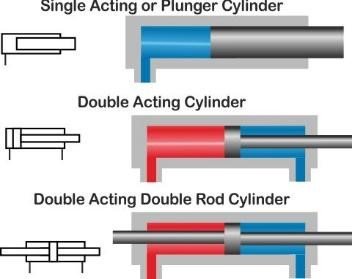
De même, dans les vérins à double effet, la pression actionne alternativement le piston dans les deux sens, tandis que dans les vérins à simple effet, la course de retour est généralement assurée par une force extérieure ou la gravité. Cependant, ces deux types de vérins obéissent à la loi de Pascal. Pour choisir le vérin adapté, il est nécessaire de prendre en compte des facteurs tels que la force de sortie, la course et les contraintes d'espace. Ces critères seront déterminés en fonction des applications prévues, par exemple les ponts élévateurs hydrauliques, les dispositifs de serrage et les engins de chantier comme les pelles hydrauliques et les chargeuses.
Soupapes hydrauliques et loi de Pascal en hydraulique
vannes hydrauliques Les distributeurs hydrauliques jouent un rôle crucial dans l'application de la loi de Pascal en hydraulique aux principes de conception. Ce principe permet la transmission de la force (F = P × A) ; les distributeurs hydrauliques régissent cette transmission. comment, où, et combien La pression et le débit sont appliqués au sein du système. Les distributeurs acheminent le fluide sous pression vers les différentes chambres d'un actionneur hydraulique, déterminant le sens du mouvement par l'application d'une pression (P) sur un côté du piston (A ou B). De même, les soupapes de décharge jouent un rôle de sécurité essentiel en évacuant le fluide excédentaire lorsque la pression dépasse un seuil prédéfini, évitant ainsi toute surcharge du système.
Tous ces types de vannes obéissent, d'une manière ou d'une autre, au principe de la loi de Pascal. Si la force délivrée reste déterminée par la relation P × A, la vitesse d'application de cette force dépend de la rapidité avec laquelle le fluide remplit ou sort d'une chambre. C'est ce que la loi de Pascal nous apprend sur les systèmes hydrauliques. Ensemble, ces vannes permettent une manipulation précise et sûre de la puissance hydraulique au sein des systèmes qui reposent sur la loi de Pascal.
Pourquoi la loi de Pascal domine les applications industrielles
La loi hydraulique de Pascal se retrouve dans tous les secteurs d'activité car elle :
- Réalisez des forces énormes, impossibles à atteindre avec des liaisons mécaniques ou des systèmes électriques de taille/poids comparables.
- Contrôle de la vitesse et de la force à variation continue grâce à la manipulation du débit et de la pression par une vanne.
- Transmettez facilement l'énergie sur de longues distances et autour des obstacles grâce à des tuyaux flexibles.
- Rediriger rapidement la puissance grâce aux vannes.
- Fournir une puissance importante par rapport à la taille des composants.
- Sécurité intégrée grâce à des soupapes de décharge de pression. Les systèmes peuvent se bloquer sans dommage en cas de surcharge (ouverture de la soupape de décharge de pression).
Applications industrielles concrètes de la loi de Pascal
| Sr. # | Application | Principe de fonctionnement | Application |
| 1 | Presse hydraulique (Fabrication et formage des métaux) | Une faible force d'entrée est appliquée à un petit piston, qui transmet la pression à un piston plus grand par l'intermédiaire d'un fluide hydraulique. Ceci crée une force de sortie beaucoup plus importante. | Utilisé pour le forgeage, l'estampage, le pliage et le formage de tôles dans les industries automobile et aérospatiale. |
| 2 | Excavatrices et engins de terrassement (matériel de construction) | Les vérins hydrauliques utilisent la pression d'un fluide pour soulever et déplacer des bras ou des godets lourds. | Permet de soulever des tonnes de terre, de béton ou de débris grâce à des vannes commandées par joystick et des circuits hydrauliques. |
| 3 | Systèmes de freinage hydrauliques (Industrie automobile et ferroviaire) | La pression exercée sur la pédale de frein est transmise par le liquide de frein, poussant des pistons qui serrent les plaquettes de frein sur les roues. | Assure un freinage puissant et constant avec un effort minimal sur les véhicules et les trains. |
| 4 | Ascenseurs hydrauliques (Entrepôt et manutention) | La pression du fluide soulève les plateformes ou les marchandises grâce à des pistons hydrauliques. | Utilisés dans les chariots élévateurs, les quais de chargement et les ascenseurs industriels pour un transport vertical efficace des charges lourdes. |
| 5 | Machines de moulage par injection (industrie des plastiques) | Des systèmes hydrauliques à haute pression poussent le plastique fondu dans des moules. | Essentiel dans la production en série de composants en plastique tels que les conteneurs, les boîtiers et les pièces automobiles. |
| 6 | Systèmes de contrôle des aéronefs (aérospatiale) | La loi de Pascal régit le mouvement des fluides dans les actionneurs hydrauliques qui commandent les volets, les gouvernails et le train d'atterrissage. | Permet un contrôle précis et fiable des surfaces de vol sous des charges et des vitesses élevées. |
Conclusion
L'exigence de confinement du fluide pour obtenir une multiplication de la force, telle que définie par Loi de Pascal, est intrinsèquement intégrée à la conception et au fonctionnement des composants hydrauliques tels que les pompes, les vérins, les distributeurs, tuyaux et conduites de transmission. Ce principe fondamental garantit une répartition uniforme de la pression dans l'ensemble du système, permettant un contrôle précis et un transfert de puissance efficace. Une bonne compréhension technique de la loi de Pascal est essentielle pour la conception, le diagnostic et le fonctionnement sûr des systèmes hydrauliques dans les applications industrielles.
N'hésitez pas à nous contacter Hydraflu pour tous vos besoins en composants hydrauliques.

