


One of the main components or devices used in the industries all over the world are DC motors. Their application across industries is wide as they offer reliable performance and allows the usage of various configurations across different machines and equipment.
After all, Hydraflu DC motors are crucial in almost all major and minor industrial applications where precise speed, control and strong starting torque are required.
Due to this variation, each device requires a separate setting for converting direct current electrical energy to mechanical energy. This is why it is important to learn about the different types of DC motors and their industrial uses, and that is exactly what we will be discussing in the article.
Different Types of DC Motors Explained
Each DC motor has been designed for different operational needs. These can vary from lifting heavy loads to running precision automation systems. This is where it gets important to understand how each type works and aids a specific industry into selecting the right DC motor for efficiency, safety, and productivity.
Here is a list of DC motors and sub motors in the following table below:
| The types of DC motors used in the industry | ||
| Main Dc Motor Type | Sub-Type | Key Features |
| Brushed DC Motor | Series DC Motor |
|
| Shunt DC Motor |
| |
| Compound DC Motor |
| |
| Permanent Magnet DC Motor |
| |
| Brushless DC Motor | Outrunner |
|
| Inrunner |
| |
| Coreless DC Motor |
| |
| Stepper Motor | Permanent Magnet Stepper |
|
| Variable Reluctance Stepper |
| |
| Hybrid Stepper |
| |
1. Series DC Motor
A series DC motor is ideal for when lifting heavy loads is required. This is possible due to the extremely high amounts of torque produced by the field winding being done in series with the rotor.
The working goes something like this: as the load goes up, the current levels go up as well, increasing the strength of the magnetic field, which in turn results in high amounts of torque.
Because of the greater amounts of torque, the speed is rather slow. As we know that torque is inversely proportional to speed, if we increase the speed the torque is lowered. But as this DC motor is used for heavy lifting, the speed is reduced to allow the focus to be on the torque. This is why this motor has a high starting torque as compared to others.
One thing to be aware of is that this type of motor should not be used with zero loads.

Industrial Uses
When it comes to the industrial uses for this type of DC motor, you have a list of things that require carrying heavy loads. This is especially important when moving large heavy objects that are stationary, and they need to be carried from one point to another.
The most common industrial uses for this type of DC motor are as follows:
- Cranes
- Hoists
- Elevators
- Electric traction systems
- Rolling mills
2. Shunt DC Motor
When looking at other DC motor types, the shunt motor is the simplest of them all. The configuration is in a parallel position between the armature and the field windings.
The rotor rotates due to the direct flow of the DC current, which is caused by the initiation of the magnetic field. The magnetic field remains unchanged no matter whether the load is high or low.

The most important aspect of this motor is that the speed remains constant for as long as it is operational. The speed can be increased, but for that the voltage needs to be amped up to
do so.
Industrial Uses
Shunt motors are preferred where speed must remain steady. This makes it ideal for applications that need steady operations. This includes grinders, cutters, conveyor belts, fans, blowers and lathe machines.
3. Compound DC Motor
When the application requirement is to provide high levels of torque and steady speeds, the compound DC motor is ideal. This motor has both series and shunt DC motors integrated in a windings configurations.
The way this works in conjunction is that the shunt winding is responsible for the stable speed, whereas the series winding works to provide the high levels of torque.
Because they work in tandem with each other, it creates a near perfect synergy between the two windings, balancing control and power at the same time. This offers a steady and enhanced speed regulation while also giving high starting torque under various levels of load.
Industrial Uses
Compound DC motors are used where loads can change frequently, but the operation still requires a steady speed with strong torque. Such applications include:
- Elevators
- Press machines
- Shearing machines
- Heavy conveyors
- Industrial mixers
4. Permanent Magnet DC Motor (PMDC)
For a more cost effective, light and compact sized DC motor, the PMDC, also known as the Permanent Magnet DC Motor, is the best choice. The magnetic fields are excited due to the placement of permanent magnets, making them light weight.
This in turn results in a low level of torque and reduced speeds, making them ideal for light to medium loads. However, this allows the PMDC motor to offer increased control during its applications. 
Industrial Uses
Additionally, this DC motor has fewer components and a simple linear design, so they are easy and cheap to manufacture while also being low maintenance and energy efficient. For these reasons they are used in the automobile, electronic and robotic industries.
5. Brushless DC Motor (BLDC)
The brushless DC motor, as its name suggests, is a motor that does not use brushes in its manufacturing of the motors. The coils are fixed in their places but are not located on the rotor. Whereas the rotor is a permanent magnet, and because the coils do not move, the commuter and brushes are not required.
The stationary magnets generate a magnetic field that is fixed in its place, so in order to alter the rotation speeds, the magnitude of the voltage for the coils need to be changed. The controls are electronic for commutation, which reduces wear and tear due to friction.
Industrial Uses
The overall operations of the brushless motor offer high levels of efficiency, longer lifespan and quiet operation. This makes them ideal for a number of industrial uses such as HVAC systems, automation equipment, CNC machines, motion control and even industrial robots.
Hydraulic DC Motors & Their Industrial Uses
Hydraulic DC motors play a critical role in modern lifting, transport, and mobile equipment. Here are some DC motor models designed by Hydraflu Hydraulics specifically for material handling, lifting systems, and special-purpose vehicles.
These motors are engineered to deliver the following:
- High torque output
- Stable operation
- Reliable performance in demanding environments
DC Motors for Lifting Equipment
Hydraulic DC motors are widely used in lifting platforms such as:
- Semi-electric stackers
- Elevated forklifts
- Scissor lifts
- Mini lifting platforms
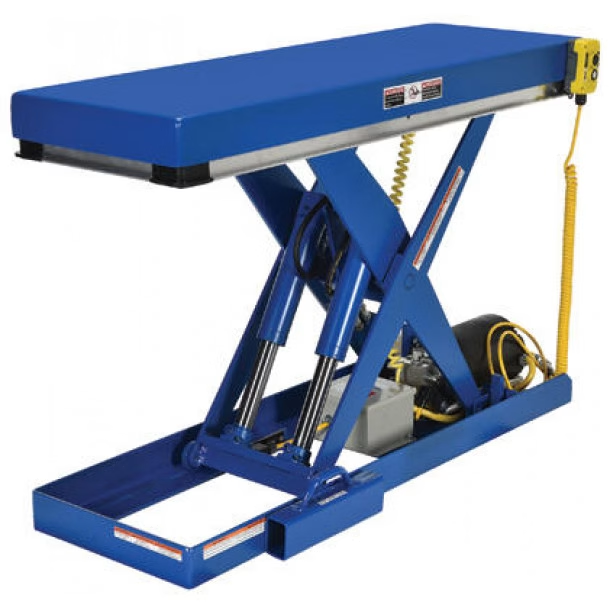
These applications require strong starting torque and controlled movement — making DC motors an ideal solution.
The catalogue highlights motors specifically designed to ensure operations such as:
- Smooth lifting motion
- Load stability
- Operational safety
These motors enable efficient lifting operations in warehouses, logistics hubs, and manufacturing facilities.
DC Motors for Mobile & Utility Vehicles
Hydraulic DC motors are also used in mobile equipment such as:
- Electric towing vehicles
- Submersible transport units
- Trailers
- Utility vehicles used in challenging terrains


These environments demand motors that can perform reliably under:
- High load conditions
- Moisture exposure
- Outdoor operation
The catalogue includes motor systems built for:
- Durability
- High torque output
- Continuous performance
Such motors are ideal for logistics yards, construction zones, and outdoor industrial transport systems.
DC Motors for Industrial Vehicle Systems
Another major application area is vehicle-mounted hydraulic systems, including:
- Tailgate lifts
- Dump trucks
- Dock levelers
- Waste disposal vehicles
These systems rely on DC motors to:
- Lift heavy loads
- Control hydraulic movement
- Provide stable operation under varying weight conditions
The catalogue features motors engineered for:
- High lifting torque
- Efficient energy usage
- Reliable performance in heavy-duty operations
These solutions are essential for logistics, waste management, and transportation industries.
Here is a table that clearly lists down each motor type and matches it to a specific industry with which it is applied to.
| Motor Type | Preferred Application |
| Series DC Motors | Electric trains, Cranes, and Industrial Loading Elevators. |
| Shunt DC Motors | Lathes Machines, Fans, and blowers. |
| Compound DC Motors | Mechanical Presses, Mechanical Shears, and Elevators |
| Permanent Magnet DC Motors | Portable tools, Toy motors, and Car window mechanisms. |
| Brushless DC Motor (Outrunner) | Drones, RC models, e-bikes. |
| Brushless DC Motor (Inrunner) | Robotics, high-speed power tools. |
| Coreless DC Motor | Medical devices, robotics, and drones. |
| Stepper Motor (Permanent Magnet Stepper) | Printers, CNC machines, and 3D printers. |
| Stepper Motor (Variable Reluctance Stepper) | Light positioning systems. |
| Stepper Motor (Hybrid Stepper) | High-precision CNC, robotics, and industrial machines. |
It is important to note that some of these DC motors can be used in combination with other industries based on their specific requirements.
Conclusion
DC motors are ideal for when industries require peak and controlled performance under heavy loads. They offer controllability and flexibility under numerous conditions and applications. This is why it is important to choose the right type of DC motor as it can make it break their productivity, safety and efficiency.
Hydraflu Hydraulics Tech Co.
Hydraflu Hydraulic Tech Co. is a leader in the manufacturing and supplying of Hydraulic DC Motors and hydraulic components. You can explore our Hydraulic DC motors of with a lot of variety at Hydraflu DC Motor. In case you have a query, do contact us.

