



Have you ever found yourself wondering why a nut is not fitting into the bolt? What does that spiral pattern on the bolt mean? Threads are the unsung heroes of engineering, connecting, holding, and keeping the world moving around. It’s all about the components that hold everything from handheld drills to Wartsila Marine Engines. In this article guide, you will learn all about types of threads.
How to Identify and Classify Threads
Identifying and classifying threads is tricky because there are many profiles, pitches, and standards to consider. But here’s a straightforward way to do it. You can start by examining the thread profile. The profiles are usually “V” shaped, square, or other designs that you can learn in the coming section.
After this, you can determine the thread direction. Most threads are right-hand, meaning they tighten clockwise, but left-hand threads are used where right-hand threads might loosen under certain conditions. Once you have these details, the next step is to check the pitch, which is the distance between each crest. This will help in differentiating between threads of the same diameter. Finally, measure the diameter to see if you’re dealing with an internal or external thread. With all these details in hand, you can classify the thread type. It will be a single or multi-start, and you will be able to identify the standards it follows, such as Metric (ISO), British Standard, or others.
An Overview of Most Common Thread Types
Knowing the details of each thread type can help make better services, installation and engineering decisions. It ensures both functionality and reliability. Following are the types of threads used in industry and hydraulic machinery installation.
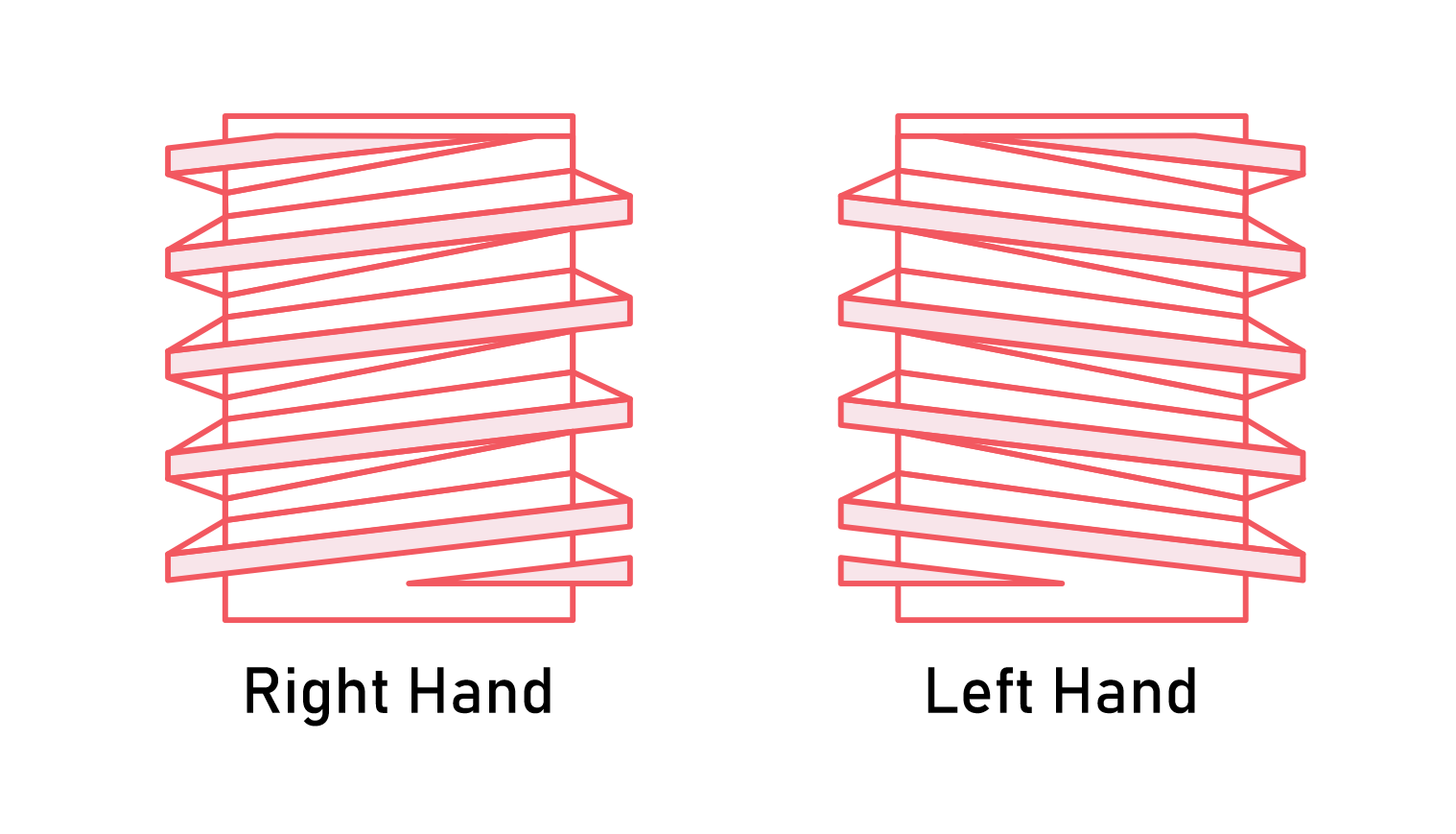
Right-hand threads
Right-hand threads are the most common type used in fastening applications, and they are designed to tighten in a clockwise direction. It makes them feel natural for most people.
Left-Hand Threads
Left-hand threads are used in situations where a right-hand thread could loosen due to motion or load. These threads tighten counterclockwise, which is opposite to most standard fasteners, making them useful when rotational forces could otherwise unscrew a right-hand thread.
They are commonly found in rotating machinery or parts that experience reverse loading, as this prevents accidental loosening. For an easy example, they are often used on bicycle pedals to ensure the rotation doesn’t inadvertently loosen the thread.
Thread Types based on Profiles and Shapes
Thread profiles play a significant role in determining the strength and functionality of the thread. Different profiles serve different purposes, and the right selection depends heavily on the specific requirements of the application. Choosing the appropriate thread profile can ensure that the thread performs optimally, providing strength, precision, or flexibility as needed.
| Thread Type | Thread Profile | Dimensions |
| Right-hand Threads | Helical groove | Tightens clockwise |
| Left-hand Threads | Helical groove | Tightens counterclockwise |
| Single-start Threads | Single helical | One groove per pitch |
| Multi-start Threads | Multiple helices | Multiple grooves for faster movement |
| “V” Shape Threads | V profile | Standardized pitch |
| Square Threads | Square profile | Low friction, high load capability |
| Acme Threads | Angled profile | Easy to manufacture, moderate precision |
| Knuckle Threads | Rounded profile | Suitable for wear and tear |
| Buttress Threads | Asymmetric profile | High axial force, one-directional |
| Taper Threads | Tapered profile | Leak-proof seal, high pressure |
| Worm Threads | Helical structure | Converts rotational to linear motion |
 “V” shape threads
 “V” shape threads
“V” shape threads are the most common type, known for their good strength and sealing properties. These threads are typically used for general fastening because they provide a reliable balance of strength and ease of manufacturing. The “V” profile helps maintain tightness under various conditions, which makes it a versatile choice.
You’ll see these threads everywhere, from small hydraulic machines to heavy-duty industrial bolts, because of their adaptability and reliable performance.
Square Threads
Square threads are designed for power transmission and are commonly used in lead screws where low friction is required. Their shape allows for efficient movement with minimal wear. This makes them ideal for applications involving heavy loads.
The flat sides of the square thread help reduce slippage under force, providing reliable performance in precision machinery. These threads are often found in systems like linear actuators, where smooth, consistent force is necessary.
Acme Threads
Acme threads are similar to square threads but have a slightly angled profile that makes them easier to manufacture. They are often used in applications like vices, jacks, and other tools where both strength and smooth movement are required.
The angled sides make Acme threads more robust under load compared to square threads while keeping friction relatively low. This balance of features makes them a popular choice for mechanical systems that require moderate precision and reliability.
Knuckle Threads
Knuckle threads are characterized by their rounded crests and roots, making them suitable for applications involving frequent wear and tear. The rounded profile helps distribute stress more evenly. This reduces the risk of thread damage over time. These threads are often found in light-duty applications such as railway couplings, where durability is key.
Buttress Threads
Buttress threads are used in applications where force is applied mainly in one direction. It provides high strength and excellent load-bearing capacity. These are particularly useful in hydraulic presses and other hydraulic equipment where high axial force is common.
The asymmetric design of buttress threads allows them to handle significant loads efficiently, without compromising on structural integrity. These threads are often chosen for heavy-duty machinery that requires unidirectional force transfer.
Taper Threads
Taper threads are designed to create a tight, leak-proof seal and are commonly used in piping and plumbing. The tapered profile wedges into the corresponding thread as it is tightened, which creates a strong seal. This makes taper threads ideal for high-pressure applications where leakage must be avoided at all costs. They are widely used in gas and fluid systems.
Worm Threads
Worm threads are typically found in gear assemblies and are used to convert rotational motion into linear motion. They feature a helical structure that interacts with a worm wheel, providing precise movement control. This makes them ideal for hydraulic lifting mechanisms and automotive steering systems where controlled movement is crucial.
Worm threads are essential for systems that need a reduction in speed and an increase in torque, providing significant mechanical advantage.
Thread Standards and Classifications
Understanding thread standards is crucial, especially in today’s globalized environment where international projects are common.
Basic Thread Types and International Standards
a) General Fastening Threads
| Thread Type | International/Regional Standard | Typical Applications | Key Features |
| UNC/UNF | ASME B1.1 (USA) | North American machinery, automotive parts | Coarse (UNC) and fine (UNF) threads, ideal for high-vibration environments |
| Metric Threads | ISO 68-1 (Global) | European/Asian machinery, electronics | Metric threads, measured in millimeters (e.g., M6, M12) |
| BSPP/BSPT | ISO 228-1 (Parallel)/ISO 7-1 (Taper) | European hydraulic systems, pipe connections | BSPP requires O-rings, BSPT is self-sealing |
| NPT/NPTF | ASME B1.20.1 (USA) | North American piping, hydraulic systems | Tapered threads, NPTF (dry seal) offers better leak resistance |
b) Special-Purpose Threads
| Thread Type | International Standard | Application Fields | Technical Features |
| MJ Threads | ISO 5855-2 (Aerospace) | Aerospace fasteners (bolts, nuts) | Rounded root design, high fatigue resistance, requires special tools |
| ACME Trapezoidal | ASME B1.5 (USA) | Heavy machinery (jacks, lead screws) | Trapezoidal profile, suitable for high loads and bidirectional motion |
| UNJ Threads | NAS 1591 (Aerospace, USA) | Aircraft structures, high-stress components | Rounded root, enhanced crack resistance, MIL-STD compliant |
| PG Threads | DIN 40430 (Germany) | Electrical cable glands | Metric threads for waterproof and dustproof sealing |
Pipe and Hydraulic Thread Standards Comparison
| Standard Name | Region | Thread Type | Sealing Method | Typical Pressure Range |
| ISO 1179 | Global | BSPP (G-series) | Parallel threads + O-ring/gasket | ≤40 MPa |
| SAE J514 | North America | JIC 37° taper | Metal-to-metal taper seal | ≤70 MPa |
| DIN 2353 | Europe | 24° taper (DKO series) | Compression fitting seal | ≤63 MPa |
| JIS B0203 | Japan | PT (tapered) | Similar to BSPT, requires sealant tape | ≤30 MPa |
Construction and Safety Equipment Thread Standards
| Standard Name | Application Scenarios | Thread Type | Key Requirements |
| EN 13564-1 | Building waterproofing (check valves) | BSPP/G-series | Corrosion-resistant materials, static pressure testing |
| EN 362 | Fall arrest connectors (safety equipment) | Self-closing gate design | Static strength ≥15 kN, salt spray resistance |
| ASME A120 | Fire protection piping | NPT | Fire-resistant coating, high-pressure sealing tests |
Choosing the Right Thread for Your Application
Each scenario points to a different type of thread, its profile, and the right material, helping you make an informed choice that ensures both stability and effectiveness.
Conclusion
Threads might be small, but their impact is colossal. Whether you’re an engineer, a technician, or someone who loves to tinker, understanding the different types of threads and their applications will give you a solid foundation for making informed choices—and maybe even impress a colleague at the next design meeting. So next time you see a screw, look beyond the twisted piece of metal. See the thought, the design, and the potential held within that simple spiral.

