


 Unregulated high pressure in fluid (hydraulic) systems increases chances of equipment failure, leaks, and inefficiencies. Critical components require optimal pressure for safe operations that is only possible through pressure reducing valves. These valves react to system needs by reducing pressure, therefore precisely regulating downstream pressure.
Function, Purpose and Benefits of Pressure Reducing Valves
Regardless of pressure fluctuations, pressure reducing valves automatically adjust pressure to keep the required hydraulic pressure. Their main job is the control of system pressure when it becomes higher than the required limit.
Functioning Principle of Pressure Reducing Valve
A pressure reducing valve is a normally open control valve equipped with an adjustable spring and a movable spool. The spring force, set by the adjustable screw, determines the downstream pressure required in the system. The movable spool manages the downstream pressure by adjusting the flow. The valve has inlet and outlet ports to facilitate fluid flow from the pressure line to the system, and a drain line in the spring chamber to redirect leaked fluid back to the tank. Furthermore, a control signal line inside the valve transmits downstream pressure signals to the spool for regulation, as shown in the schematic diagram.
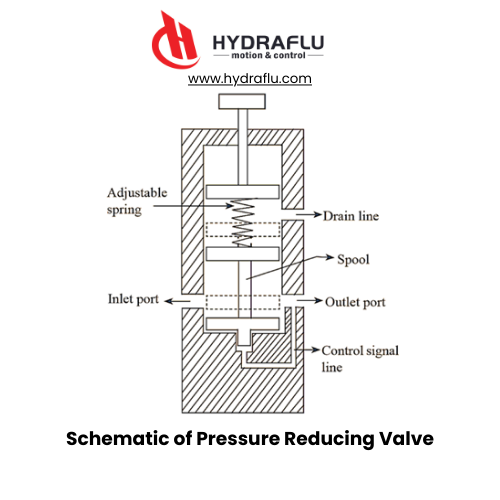
How a Pressure Reducing Valve Works?
To let you better understand the working principle of a pressure reducing valve, I will explain the two types of Pressure Reducing Valves acccordingly.
Direct-acting pressure reducing valve
This is a Hydraflu producing pressure reducing valve model:PRC 10-32 which is direct-acting PRVs. Let me explain to you exactly how a pressure reducing valve works.
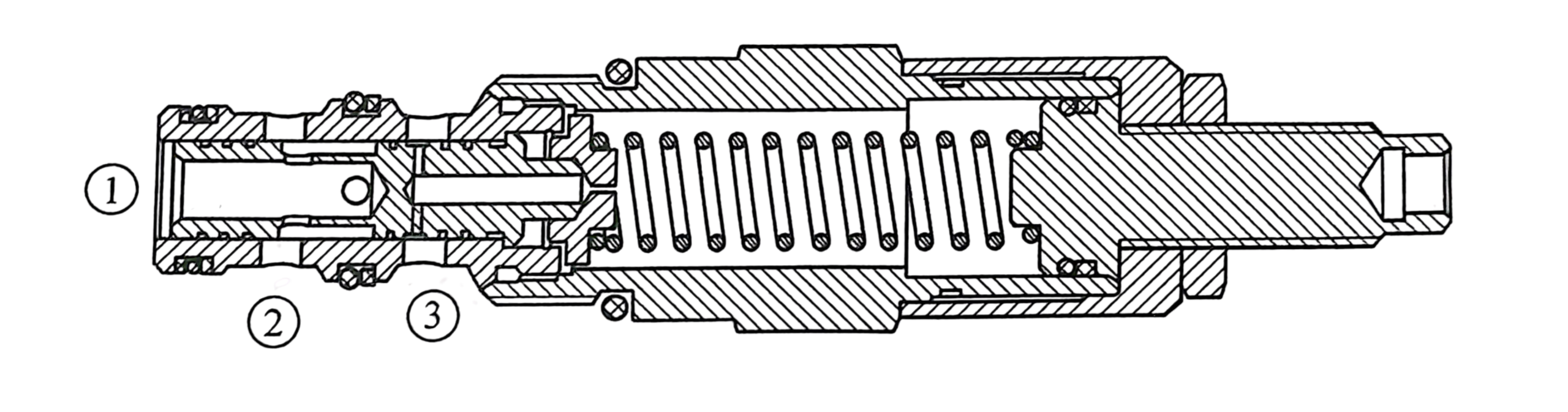
Initially, when the downstream pressure at port ① is below the preset spring force and the force of port ③, fluid flows unobstructed from the inlet port ①to the outlet port ②. However, if the downstream pressure reaches the preset value and the force of port③. This causes the spool to move upward against the spring force, fully closing the outlet port. Any fluid leaking into the spring chamber is drained into the system from port ③, as a relief valve preventing a pressure build-up exceeding the configured limit in the pipeline.
Pilot-operated pressure reducing valve
Here is an illustrator of a pilot-operated pressure reducing valve, Hydraflu model:PRC 10-36.
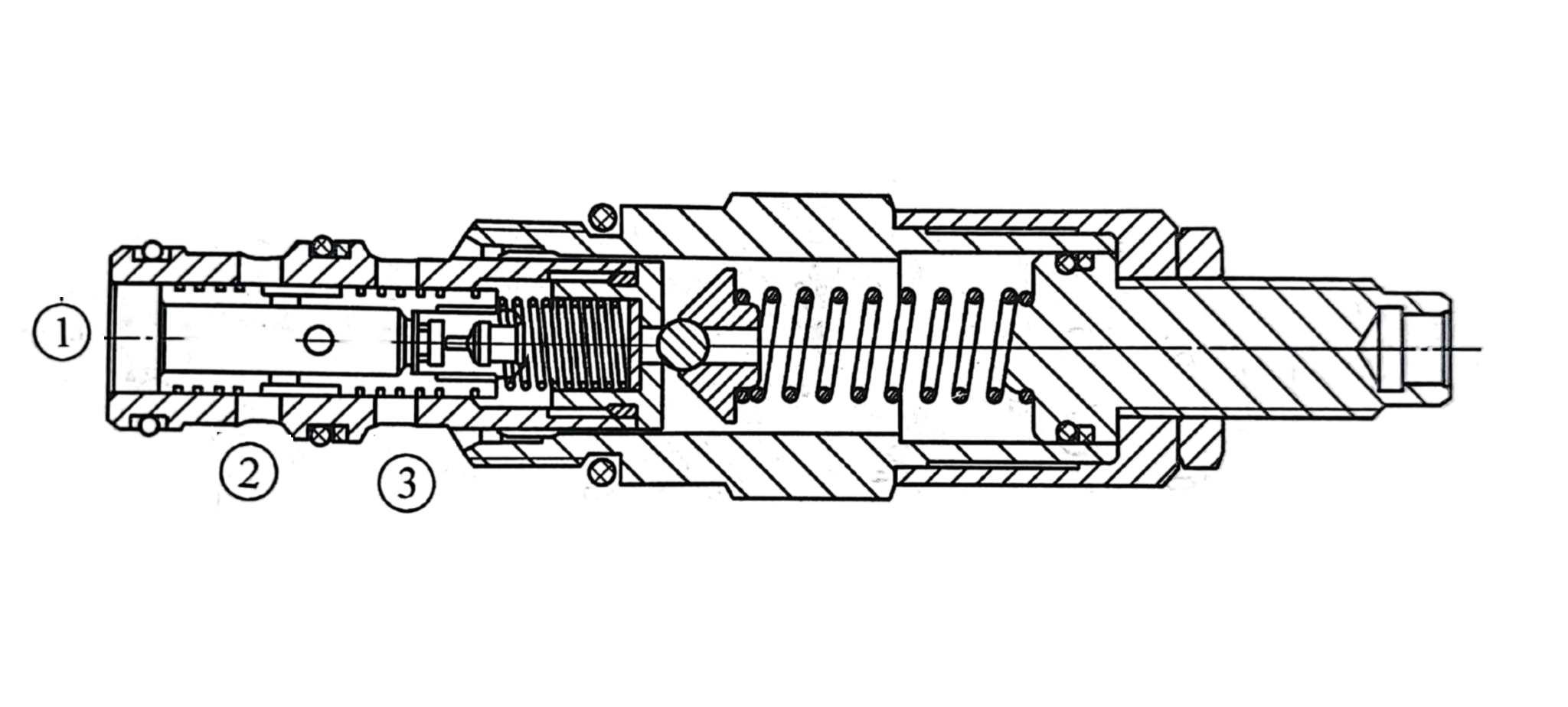
The working procedure is the same as the PRC10-32, before the downstream pressure is below the preset value, and it has free flows between port ① and port ②. Once the pressure exceeds the preset value and pressure of the port ③, firstly open the pilot valve. The pilot fluid flows through the orifice on the main spool, creating a pressure difference that pushes the main spool to close the path between ① to ②, then opens the path from ① to ③ as a relief valve function.
Benefit of Pressure Reducing Valve
1.System Protection
Though the core function of the pressure reducing valves was mentioned above, they do much more than that. These valves prevent pipe bursts, and damage to appliances and hydraulic equipment (like hydraulic pumps, fittings, lift gates, hydraulic valves, dock levelers, hoses, sealing, etc.). Sometimes the overpressure systems cause leaks.
For instance, the American Water Works Association (AWWA) notes that pressure surges exceeding 100 psi can increase pipe failure rates by 300%.
2.Efficiency Optimization
By maintaining optimal pressure, PRVs can improve system efficiency and potentially reduce water waste and maintenance costs. For instance, lowering pressure by even 10 psi can reduce chances of leakage of hydraulic systems by 5–7%, according to the ANSI. When this factor is considered on a large scale, the efficiency can be observed to be increased by 31% for the whole hydraulic system.
3. Cost Savings
Furthermore, a 2024 study by the ASME found that utilities using PRVs reduced non-revenue hydraulic oil loss by 25–30%, translating to millions saved annually.
| Parameter | Direct-Acting PRVs | Pilot-Operated PRVs |
| Pressure Range | 80–2100 psi | 100–3000 psi |
| Accuracy | ±10% | ±2% |
| Flow Capacity | Up to 10 GPM | Up to 30 GPM |
| Materials | Steel, Stainless steel | Steel, Stainless Steel |
Common Applications
Pressure Reducing valves are widely used in hydraulic systems, equipment, machinery, water distribution networks, boilers, homes, businesses, and industrial settings. Some of the most common and critical applications of pressure reducing valves are as follows:
- To safeguard sensitive components/ elements (e.g., gauges, sensors) by capping inlet pressure to prevent damage from system overpressure.
- To enable specific hydraulic circuit branches to operate at lower pressures than the main system for varied functional requirements.
- To reduce the risk of leaks or bursts by maintaining preset pressure limits in vulnerable sections of the system.
- To reduce pressure in non-critical zones (e.g., positioning mechanisms) to lower energy consumption and operational costs.
- To facilitate fine control in applications like robotic/ hydraulic arms or delicate actuators requiring stable, low-pressure inputs.
- To adjust pressure for interchangeable attachments (e.g., tractor tools) without altering the primary system pressure in mobile hydraulic equipment.
- To support stepped pressure reduction in complex setups, allowing sequential pressure drops for specialized subsystems.
Conclusion
Pressure Reducing Valves are essential for modern fluid systems. They are constructed by blending mechanical precision with cost-saving benefits. So, from safeguarding hydraulic machinery to optimizing industrial steam networks, this valve improves system reliability. To learn more about pressure reducing valves, contact Hydraflu today. Moreover, you can explore the more product by clicking here.

