


Introduction
Both Hydraulic and Electric motors are designed to accomplish the same task, actuating the rotational motion and generating torque. Now which one is best for your industrial application, depends on where and for what purpose you want an actuator to be installed. By the end of this article, you will be able to ready to choose one from both for your work.
Hydraulic Motors and Electric Motors
Hydraulic schematic symbol:
Hydraulic motor: 
Electric motor: 

Hydraulic motors convert hydraulic pressure and flow into torque and rotational motion. These are actuators enclosed in hydraulic casing or circuit, whatever you name it. When heavy-duty machinery needs a rotational motion, these motors are recommended by engineers.
Electric motors is different from hydraulic motors in working principle,while it convert the electrical energy into mechanical energy. Check out the basic knowledge of electric motors.
Structure of different types of hydraulic motors
The main principle in all types of hydraulic Motors is to convert fluid pressure into rotational motion. It is the same for all types of hydraulic motors. However different types have different construction schemes such as Vane motors, Gerotor, Gear motors, Plunger motors and Radial motors.
As you see from the chart Hydraulic motors are divided into various categories. Each of the types has its own design principle and usability. For example, vane motors are used for moderate applications where neither higher torque nor lower torque is required such as fans and blowers, whereas if high pressure or torque is needed, radial piston motors are used.

Hydraulic Vane Motors
 This motor has a housing with an off-centre bore. The rotor has vanes attached to it that rotate when the pressurized fluid hits the vanes. This rotation is due to an imbalanced force created by fluid striking with the vanes of the rotor. Due to a seal formed between the rotor and housing, the metal-to-metal contact is the least, as a result, it increases its overall wear and tear life.
Hydraulic Piston Motors
Radial Piston motors are classified into 2 types based on the direction of motion of the piston in each.
Hydraulic Motors with Pistons Pushing Inward
It has a single-cam crankshaft where pistons push inward. This motor is best for high starting torque and also allows smooth operation, even when reaches high rpm with stable torque output.
Hydraulic Motors with Pistons Pushing Outward
This type of motor as shown in the figure with a cylinder head type structure, has multiple lobes. In this type, the piston pushes outward against the cam ring which generates smooth rotational output. It has a high starting torque but is a low-speed motor. This production of a high-torque makes it best suitable for high-powered applications where the capacity of load is heavy, e.g. in heavy machinery.
Hydraulic Axial Motors
These types of motors use reciprocating pistons in both fixed and variable displacement designs. Furthermore, plunger motors in high-quality rotating drive systems often require a gearbox due to the lower speeds needed by driven machinery.
Hydraulic Gerotor Motors
The gerotor motor consists of an off-centre rotor with one less tooth than the stator. When a pressurized fluid enters via a distributor valve, it causes the rotor to rotate. This type of Hydraulic Motor is best suitable for applications where a medium-level torque and speed are required.
Hydraulic Gear Motors
As the name says, this motor is governed by two gears. As shown in the figure a casing contains two meshed gears where one is driving the other. An idler with a driver’s gear. The pressurized oil flows around in the housing which produces a rotational motion.
The debate between hydraulic v/s electric motors is not that complex if you know why one is preferred over the other in certain environments.
Hydraulic Motors’ Pros and Cons
No matter which motor type within the hydraulic motor category you choose, they have similar advantages and disadvantages as compared to electric motors. You can learn some of the important and key advantages and disadvantages of hydraulic motors from the table below:
So, selecting between them depends on the specific requirements of torque, control, efficiency, and operating conditions. You can learn the detailed difference between both of them in the chart below:

Electric Motors’ Principles, Pros and Cons
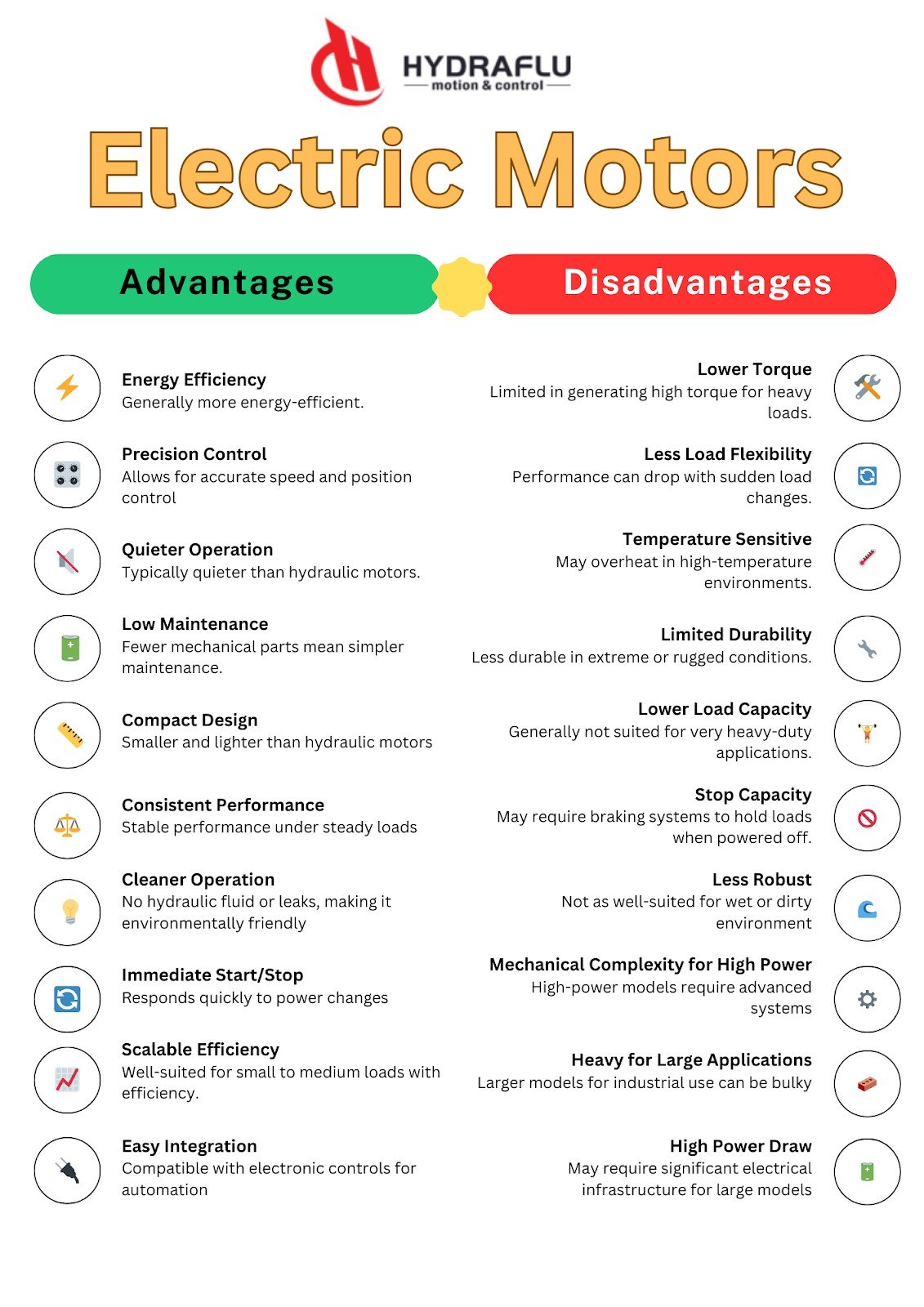
Electric motors bring a lot to the table. The energy efficiency, accuracy and control with less noise make it ideal for sensitive applications as compared to hydraulic motors. There are many points that can be considered a plus for electric motors over Hydraulic motors, like a steady speed and accurate position. 
Electric motors are also more compact, smaller and lightweight as compared to hydraulic motors. This compactness makes them ideal for small spaces. Electric motors have many types and categories.
There are advantages as well as some comparative disadvantages. Learn some of the pros and cons in the given chart:
When Choosing a Hydraulic Motor, consider these factors
Now you have learned a lot about the pros and cons of both types of motors. This might have confused you. To get more clarity, you need to look into some facts and understanding of the installation site and purpose. These can be calculated and observed. Making some technical notes is the best technique to get clarity for selection.
That is why, you are recommended to keep certain factors under consideration before making a choice such as:
Application Requirements for Hydraulic Motors
Hydraulic motors excel in heavy-duty applications. These can be the ones that need high torque and high power. Such as the machinery used in construction, mining, and agriculture.
Speed, Torque, and Environment Consideration
If you need less speed and more torque in a rough environment, Hydraulic motors are ideal for you. Because, these motors can withstand wet, dirty, or high-temperature conditions.
Balancing Performance with Cost
Though hydraulic systems have higher upfront and maintenance costs, against this investment they offer long-term durability and performance, especially under heavy loads.
Maintenance Capabilities
If you want to know about maintenance, then please learn that regular maintenance is crucial for hydraulic systems, including checking fluid levels and replacing worn components.
Energy Efficiency Goals
Energy efficiency is lower in Hydraulic motors than in electric motors. If the power/torque is considered, efficiency may be secondary to output.
When to Choose an Electric Motor and Why?
Similarly, confusion may arise in the selection of an electric motor. Regardless of which type of electric motor you need to install, the factors are similar. Most importantly learn about IP rating concerning tough environment applications. These factors should be kept under consideration before making a choice, such as:
Application Requirements
If you are looking for accuracy and precise motion, electric motors are ideal for such applications. For example, if you want a motor for some robotic and automated systems.
Speed, Torque, and Environment
Electric motors provide efficient but comparatively less torque at high speeds. You need to consider IP ratings before making a decision.
Balancing Performance and Cost
Electric motors generally have lower initial and maintenance costs, making them a cost-effective choice for applications with moderate power needs.
Maintenance Capabilities
Electric motors require less maintenance than hydraulic motors, with fewer moving parts and no need for fluid management, which reduces downtime.
Energy Efficiency Goals
Known for their energy efficiency, electric motors are better for applications with long operating times and lower power requirements, aligning well with energy-saving goals.
Understanding Key Terminologies
There are many technical terminologies that are associated with both Hydraulic and Electric Motors. These terminologies sometimes confuse choosing the right one such as Torque, efficiency capacity etc. Here you can learn the key terminologies that can help you better understand of details that are coming in the sections ahead.
- Torque is the power or you can say a force required by the motor to move the load it is going to carry, the more torque a motor has, the more load it can move. Hydraulic motors are comparatively considered more powerful than electric motors of the same category. This is the reason they are chosen for heavy-load applications.
- Precision and Accuracy are the rotation per minute or revolution of the motors per minute. Many applications require consistent power with the same RPM. Here, hydraulic motors lack this feature to be 100% accurate, although these are very smooth still when you compare them with electric motors, it has an edge over hydraulic motors.
- The actuator is the component that converts hydraulic energy into mechanical energy through motion.
Conclusion
Both Hydraulic and Electric Motors have a lot of varieties. You need to consider the factors associated with the application as explained earlier before making a decision. A careful decision provides better efficiency and saves a lot of cost not by just correct pricing but also by operational efficiency.
About Hydraflu Hydraulic Tech Co.
Hydraflu Hydraulic Tech Co. is a leader in the manufacturing and supplying of Hydraulic and Electric equipment. You can explore products such as Hydraulic Power Pack, Hydraulic Manifold Block, AC, Dc motor, Hydraulic Valve, Hydraulic Pump, Hydraulic Hose and Fittings. In case you have a query, do contact us.

