


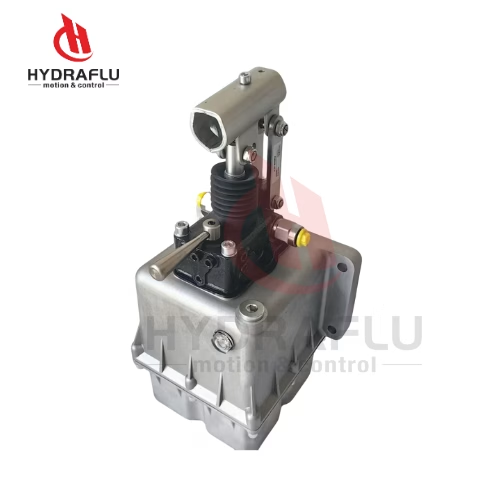
Hydraulic Manual Hand Pumps Explained
The module that creates the force inside a cylinder, which goes on to move the fluid in a hydraulic system is the pump. Without the hydraulic pump, the fluid won’t move at all.
One such hydraulic pump will be explained in this article and it is called the Hydraulic Manual Hand Pump. As its name suggests, this pump requires human labor to generate hydraulic energy through mechanical energy, creating the required hydraulic pressure to get the fluid in motion.
How Does a Hydraulic Manual Hand Pump Work
Hydraulic hand pumps may look simple, but they can deliver massive pressure and performance without electricity or complex machinery. It works on the idea of Pascal’s law, which states that a change in pressure exerted at any point in a confined fluid is transferred in its whole.
When the handle is pumped, it actuates a piston within the pump chamber. During the upward stroke of the piston, hydraulic fluid is drawn into the chamber from the reservoir. Conversely, on the piston’s downward stroke, the fluid is forced out of the chamber and directed into the attached hydraulic tool to accomplish the task.
The basic process is as follows:

- The mechanic pushes or pulls the pump handle
- A piston inside the pump forces hydraulic fluid out of the reservoir
- Fluid travels through a hose into a hydraulic cylinder or tool
- Pressure increases, causing pressing, pushing or lifting
This makes hand pumps incredibly effective for applications where precision and controlled pressure are required.
Various Components of a Hydraulic Manual Hand Pump
No mechanical system is complete without a plethora of components. These components work to ensure that the hydraulic pump generates a combination of pressure and flow. This then allows for the movement of the internal pistons and parts.
Here are some of the most important components of a hydraulic manual pump:
- Plunger/Piston: The component responsible for pressurizing the fluid inside the pump. It is manually moved up and down.
- Pump Body: All the internal components are contained inside this main body
- Hydraulic Fluid Reservoir: The housing chamber for the hydraulic oil which transfers the force
- Output Port: The outlet system of the hydraulic tool where the pressurized fluid comes out so it can power whatever hydraulic tool you’re using
- Check Valves: Prevents backflow and ensures one directional flow of the fluid
- Pump Handle: The manual level for the operator moving it up and down to generate hydraulic pressure
5 Benefits of a Hydraulic Manual Hand Pump
Hydraulic manual handpumps have numerous benefits in both regular day-to-day and industrial uses. Even though they are considered simple tools, professionals across the world rely on these contraptions.
Here are five benefits of using hydraulic manual hand pumps:
- Durable & Simple: They are cost-effective and reliable for longer periods of time due to their minimal number of components. These are low maintenance and don’t break down that often.
- Low Operational Cost: Being manually operated, the cost of fuel and/or electricity is deleted completely.
- Manual Hand Operation: No need for complex engines or electric motors to operate.
- Easily Portable: They usually come in easy to carry compact sizes, allowing the user to take them outdoors, especially in areas with no electricity or fuel availability.
- Versatile & Powerful: Can be used for medium to low level pressure applications, generating up to 10,000PSI (or 700 bar) for testing hydraulic systems, lifting equipment and automotive repair work.
Common Applications of a Hydraulic Manual Hand Pump
The most suitable applications for a hydraulic manual hand pump is when manual control, portability and mobility are of the utmost importance. This allows industries and solo contractors to use this equipment in an effective and efficient manner.
The most common utilization of hydraulic hand pumps are as follows: 
- Agricultural Lands: Used to lift heavy farm equipment and operate harvesters, plowers and seeders.
- Lifting Heavy Equipment and Construction: Powering tools like drills, breakers and hammers. Lifting various heavy construction materials like concrete slabs. bricks and formwork to aid in the construction process.
- Automotive Industry: Using manual hydraulic jacks to lift heavy parts for trucks, cars and other vehicles for repair work and maintenance.
- Marine Equipment: Manual hydraulic pumps can be used to lift and service boats and lift small ship equipment in dry docks. They are also used on board water vessels to lift and power numerous hydraulic systems.
- Manufacturing Industry Applications: Power applied via manual hydraulic pumps to bend and press metal sheets.
- AeroSpace: Aircrafts use various hydraulic systems which can be tested using manual hydraulic pumps. They are also used for positioning of equipment in a precise manner for aircraft assembly and maintenance.
Different Types of Hydraulic Manual Hand Pumps
With the various types of hydraulic manual hand pumps, each has been designed for a specific purpose and hydraulic application. They offer different levels of power and pressure, allowing their users to fulfill specific jobs related to pressing, lifting, powering or testing tools.

The two main types of hydraulic manual hand pumps are:
Single Acting Hydraulic Hand Pumps
As the name suggests, this manual hand hydraulic pump puts pressure on a single side. The stroke of the pump returns to the starting position upon completion of the full output pressure.
These are ideal for pushing and lifting equipment.
Double Acting Hydraulic Hand Pumps
This is the two-sided version of the hydraulic manual hand pump, as it creates pressure on the return stroke just as well as the forward stroke. The movement of the fluid is faster and more efficient during operating these types of hand pumps.
Perfect for use in hydraulic cylinders, where retraction and extension is required at a rapid pace.
Conclusion
Hydraulic manual hand pumps are ideal for when you don’t have access to a power source or fuel and electricity to power up a hydraulic pump. Especially in remote areas, making them practical for portability and simplicity.
This makes them versatile and durable even during this day and age of digitization and advanced automated hydraulic systems.
If you want to know more about Hydraflu’s hand pump, feel free to contact us.


