


Introduction
In low-rise buildings, such as residential complexes, manufacturing facilities, warehouses, and office buildings, hydraulic elevators are commonly utilised as a means of transportation. On average, they are not utilised in high-rise structures since they are not as quick as traction elevators, and they are restricted to a travel distance of approximately sixty feet maximum. Moreover, these hydraulic elevators are more energy-efficient than traction elevators and have the potential to handle a greater weight, requiring less money to install.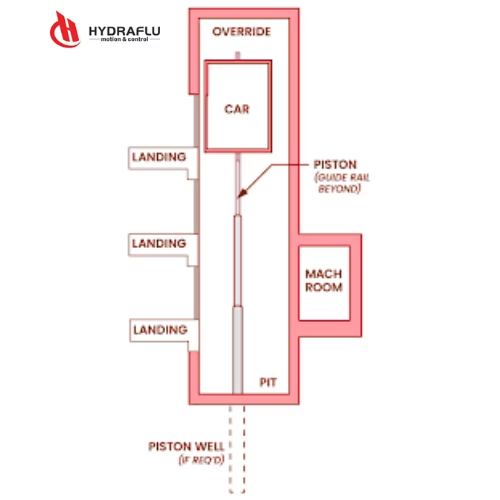
What is Hydraulic Elevator?
A hydraulic elevator gives a lifting mechanism for people, freight, hospital beds and many other applications by making use of hydraulic fluids to propel the elevator car up and down. It functions when oil is pumped into a cylinder by a pump in a hydraulic mechanism elevator, which then causes a piston to be pushed upward. The elevator car (box) is attached to the piston, which means that as the piston travels up, the elevator moves up as well. Conversely, when the pressure is removed, the elevator car moves down.

How do Hydraulic Elevators Work?
A hydraulic elevator is nothing more than a compartment that is connected to a hydraulic lifting system. A fluid-pumping system is attached to the hydraulic cylinder, and the hydraulic oil is used as the incompressible fluid to move the hydraulic rods up or down, as needed, through the use of a hydraulic valve. The function of the valve is to control the oil flow between the pump and the hydraulic cylinder. The hydraulic piston (also called the ram) is the part that moves and pushes the elevator car up or down. Moreover, there are rails for guidance that keep the elevator car straight when moving up and down, which otherwise may deflect under the load. All this system is controlled through the PLC Unit Controls through the logic for motors, pumps, and safety.

Step-by-Step Process
The operating principle of a hydraulic elevator is based on Pascal’s Law, which states that pressure applied to a confined fluid is transmitted equally in all directions.
Upward Motion (Lifting)
Like all hydraulic systems, the hydraulic elevator also gets power from a hydraulic pump that pushes hydraulic oil from the oil reservoir into the cylinder. According to Pascal’s law, the hydraulic fluid then pushes the piston up, which raises the elevator car.
Holding Position
When the lift car reaches the desired level, the hydraulic valves close and stop any further pressure increase or decrease. This step maintains the fluid pressure at the same level, and the elevator stays in its position. This remains still unless the pressure is either increased or decreased.
Downward Motion (Descent)
To move the elevator down, the manifold block acts as a controller to release oil back to the reservoir, which then drops the pressure in the hydraulic cylinder smoothly, and the elevators move downward under gravity. This process ensures an energy-efficient operation of the hydraulic elevator.
Types of Hydraulic Elevators
Within the classification of hydraulic elevators, there are many different combinations of mechanical systems, such as:

Conventional (Holed) Hydraulic Elevator
A regular hydraulic elevator lifts the car with a piston that goes down into a deep underground cylinder. This system is often put in new buildings and works well in buildings that are up to six stories tall. It is known for running smoothly and quietly, but it needs a lot of civil work because it requires a deep pit.
Hole-less Hydraulic Elevator
A hydraulic elevator without holes doesn’t need an underground cylinder because its pistons are on the sides of the shaft. This makes it perfect for buildings that are already built and can’t have a deep hole drilled. It also lowers the costs of building things and is better for the environment because it doesn’t put anything underground that could get contaminated.
Roped Hydraulic Elevator
A roped hydraulic elevator uses ropes and a hydraulic piston to make the travel distance longer, which effectively doubles the height it can reach. It works well for buildings with eight or fewer floors. This design uses less oil and a smaller piston, which makes it more efficient and saves space compared to traditional systems.
Applications of Hydraulic Elevators
Their robust load-handling capacity and cost flexibility make them a preferred choice across multiple sectors.
- Elevator for an under-8-floor building, residential areas, apartments and villas
- Car and truck jack system for maintenance
- Hydraulic Vehicles parking systems
- Hydraulic freight lifters in warehouses and in industrial facilities.

Advantages of Hydraulic Elevators
- They are cost-effective during installation as no counterweight or overhead machine room is required.
- Hydraulic elevators can handle higher loads as compared to the roped system, which makes them ideal for hospitals, freight and car lifting.
- They give smooth and quiet Operation, which makes them perfect for residential elevators and commercial environments. Explore Hydraflu’s Elevator Submersible Low-Noise Power Unit

- Their flexible machine room location allows you to position them up to 10 meters away.
- With a simple pit and shaft mechanism, low civil construction is required.

Limitations of a Hydraulic Elevator
While they offer many advantages, hydraulic elevators also have some limitations.
- The travelling speed is lower, limited to 1 m/s, and is not suitable for high-rise buildings.
- There are risks of oil leakage, which makes them require routine maintenance and proper sealing.
- While lifting, these elevators use more energy as compared to other elevator systems.
Maintenance and Safety Standards
Hydraulic elevators require routine maintenance in order to operate safely and dependably, as was mentioned in the limitations section above. Checking the oil level and viscosity, searching for seal and valve leaks, performing pressure tests, and calibrating the brakes are examples of routine tasks.
Conclusion
A hydraulic elevator is more than just a vertical transport solution with safety engineering and energy efficiency. Whether for residential, commercial, or industrial use, its adaptability, affordability, and smooth performance make it one of the most trusted elevator systems worldwide.
At Hydraflu, we offer complete solutions for the new equipment or parts for your hydraulic elevators. Feel free to contact us or visit our product database to find one-stop hydraulic system solutions and parts.

